Uncovering the atomic origin of bright quantum emitters in silicon nitride
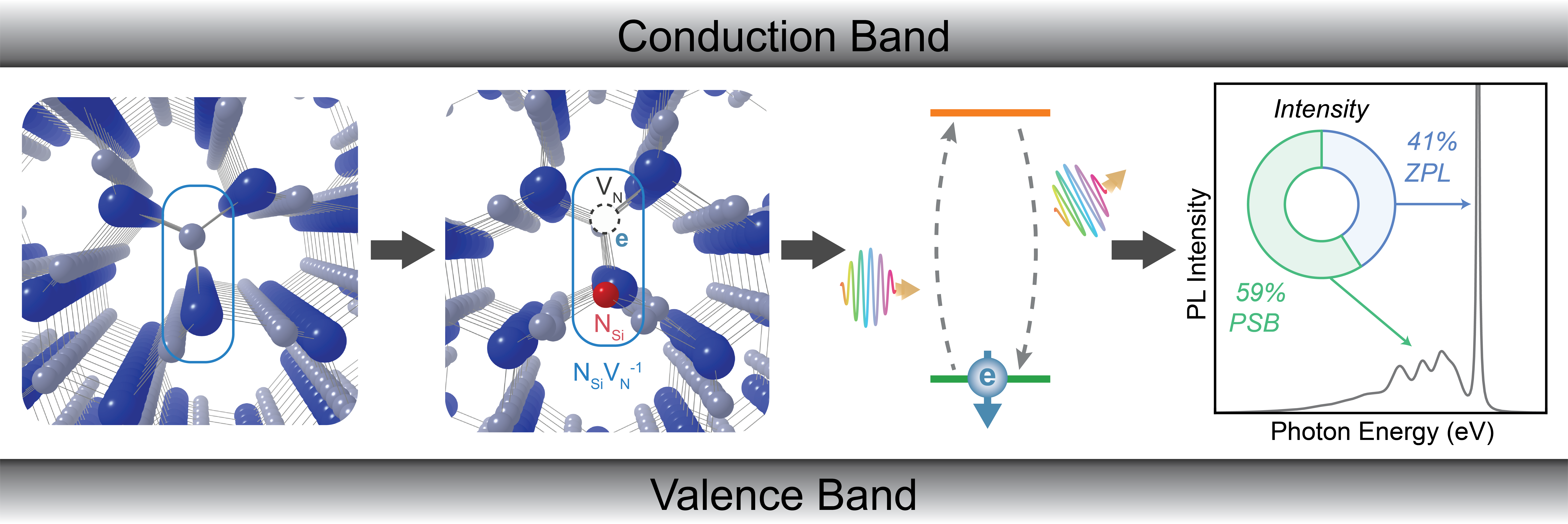
Single photon sources that are bright, stable, and compatible with existing photonic platforms are a key ingredient for emerging quantum technologies, including quantum communication, computing, and precision sensing. Silicon nitride has recently attracted strong interest as a scalable platform for integrated quantum photonics, following experimental demonstrations of room temperature single photon emission. However, the microscopic origin of these bright quantum emitters has remained unclear.
In a new study, researchers led by Abhishek Kumar Singh from the Materials Research Centre, IISc, along with PhD scholars Shibu Meher and Manoj Dey, have identified the atomic scale defects responsible for these emissions. Using state-of-the-art first principles density functional theory calculations, the team investigated point defects in crystalline silicon nitride to pinpoint their electronic and optical signatures.
The study reveals that the negatively charged nitrogen-antisite-vacancy complex (NV⁻) are the most likely source of the experimentally observed single-photon emission near 2 eV. The defect exhibits a bright, linearly polarised zero-phonon line with radiative lifetimes of around 9–10 nanoseconds. It shows an unusually high Debye-Waller factor of up to 41%, indicating that a large fraction of the emitted light is concentrated in a sharp spectral line, an essential requirement for quantum photonic applications.
By linking bright and stable single photon emission to a specific intrinsic defect, the work provides a microscopic foundation for the deterministic design of quantum light sources in silicon nitride. The findings pave the way for monolithic, low-loss quantum photonic circuits, and establish silicon nitride as a powerful platform for scalable quantum technologies.
REFERENCE:
Meher S, Dey M, Singh A, Origin of bright quantum emissions with a high Debye–Waller factor in silicon nitride, Nano Letters (2026).
https://doi.org/10.1021/acs.nanolett.5c06190
LAB WEBSITE: https://thsim.mrc.iisc.ac.in/



