Upcycling of red mud to catalyst
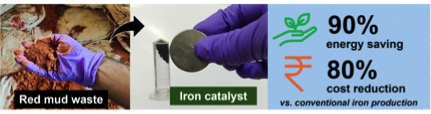
Novel method transforms red mud waste into sustainable iron catalysts, achieving up to 90% energy savings and 80% cost reduction compared to conventional iron production (Photos: Kanhai Kumar)
Every year, aluminium production generates over 180 million tonnes of a highly alkaline industrial waste called red mud. It is toxic, difficult to store safely, and capable of contaminating groundwater, and therefore one of the most pressing environmental burdens facing the global mining industry, with nearly 4 billion tonnes already stockpiled worldwide.
PhD student Kanhai Kumar (Materials Research Centre) and faculty member Karuna Kar Nanda (Materials Research Centre and Director, Institute of Physics, Bhubaneswar) have now developed a new, efficient chemical route to selectively extract iron from this waste and convert it into a high-value iron-based catalyst used in environmental cleanup.
The key innovation is an acid-leaching process that dissolves iron from red mud at just 80°C, while simultaneously neutralising the waste’s toxicity. Unlike conventional iron production – which consumes 18–22 gigajoules of energy per tonne and requires fresh ore mining – this route needs less than 3 gigajoules per tonne, reducing energy use by 10-15 times. At the lab scale, reagent costs drop to approximately Rs 1–2 per batch, compared to Rs 5–10 using standard iron salts. At the industrial scale, the gap widens further, since red mud is waste that industries already pay to dispose of.
The resulting iron oxide catalyst can convert nitrate contaminants in water into ammonia – a valuable industrial chemical – aligning with circular economy principles. It also opens new pathways to recover titanium and scandium, rare earth elements present in red mud.
This work, published in the journal Green Chemistry, demonstrates a scalable, low-energy strategy for turning one of industry’s most harmful waste streams into a valuable resource.
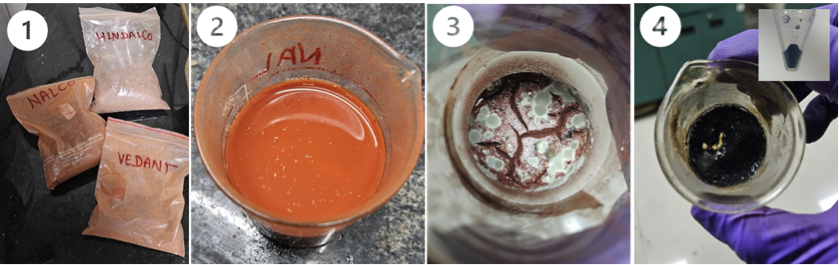
Stepwise conversion of industrial red mud waste into sustainable iron catalyst materials: (1) Collected red mud samples from different industries (2) Leaching and precursor solution preparation (3) Neutralised red mud residue showing fungal growth, indicating agricultural compatibility (4) Selective chelation of iron from step 2, using tannic acid for black Fe–tannate complex formation, yielding the high value Fe–C framework catalyst precursor (Photos: Kanhai Kumar)

Left: Karuna Kar Nanda (Professor, MRC, IISc and Director, Institute of Physics, Bhubaneswar). Right: PhD student Kanhai Kumar (MRC, IISc)
REFERENCE:
Kumar K, Nanda KK, Soil to society: Red-mud-derived iron oxide electrocatalysts for circular nitrogen upcycling via green ammonia production, Green Chemistry (2026).
https://doi.org/10.1039/D6GC01096B
LAB WEBSITE:
https://mrc.iisc.ac.in/karuna-kar-nanda/



