High-energy neutrinos from the Sun may shed light on dark matter
– Kredai Raaman
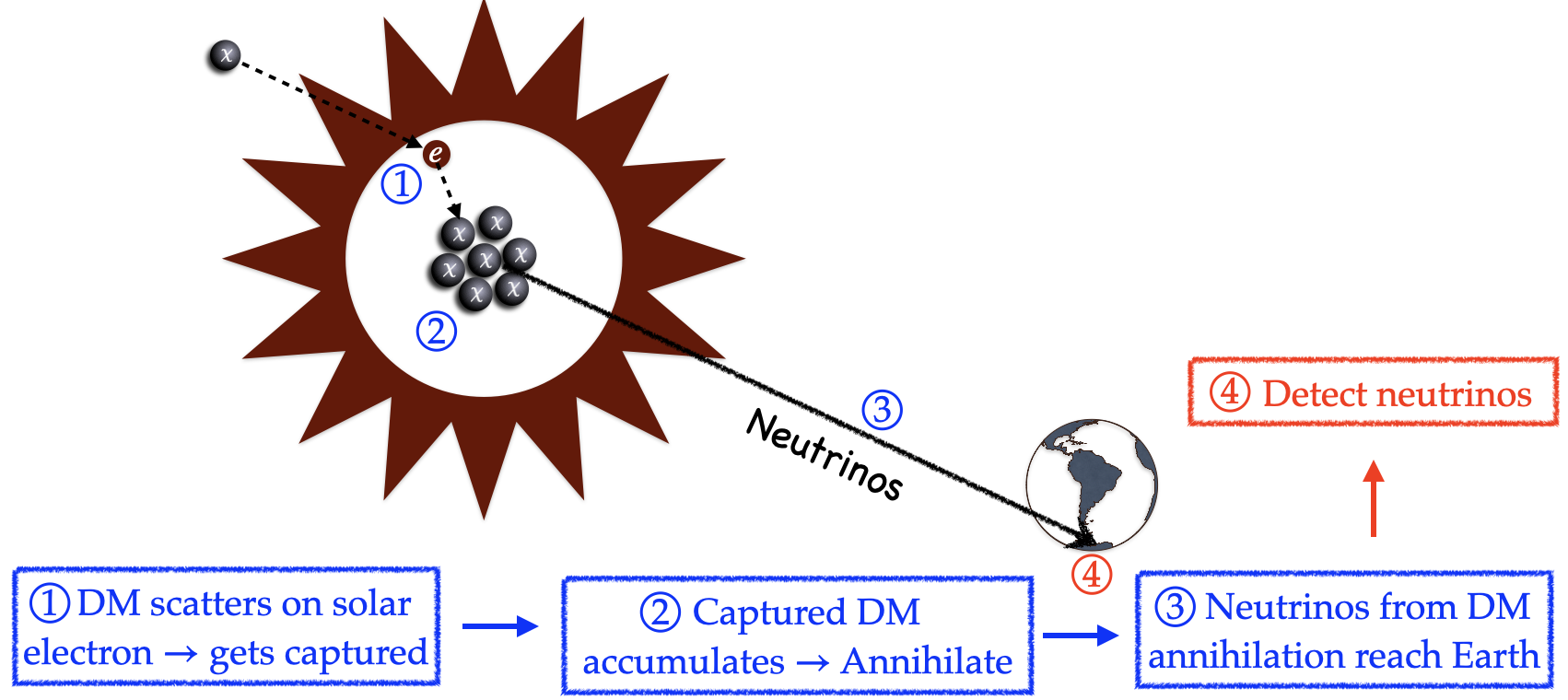
Dark matter – called so because it does not interact with light or other electromagnetic radiation – makes up more than 85% of all matter in the universe. However, we know very little about the particles that make up this mysterious substance. Scientists have traditionally focused on probing direct interactions between these dark matter particles and atomic nuclei. But a new study from Ranjan Laha’s lab at the Center for High Energy Physics (CHEP) proposes an alternative – using the Sun and the neutrinos emitted from it to understand how dark matter may interact with electrons.
Dark matter particles from deep space are constantly passing through the Sun, attracted by its gravitational potential. Without non-gravitational interactions with ordinary matter, these particles would continue on their trajectories and escape into deep space again. But if dark matter particles interact with the Sun’s electrons, even weakly, then they will lose some of their kinetic energy and can become gravitationally trapped inside the Sun. Over time, these trapped particles will accumulate inside the solar core, where they may interact and annihilate with each other, thus producing high-energy neutrinos that can escape the Sun and be detected from Earth.
The team used existing data from the IceCube and DeepCore neutrino observatories to search for such neutrinos coming from the Sun. Although they did not find an excess of neutrinos, they were still able to place the most stringent limits yet known on how strongly dark matter can interact with electrons over a wide mass range. What makes this strategy compelling is that it does not rely on observing dark matter directly, but rather on the secondary effects of its annihilation. By monitoring neutrinos – particles that are infamously hard to detect – scientists can effectively use the immense gravitational potential of the Sun as a natural dark matter detector.
The study highlights how cosmic observations can provide insight into fundamental particle physics. Neutrino astrophysics can serve as a precision probe of particle interactions in the “dark” sector, which is inaccessible to lab experiments. Critically, direct observations of the Sun – long considered to be just a background source in dark matter searches – may have a major role to play in deciphering the true nature of dark matter.
Following the suggestion by the IISc CHEP group, the IceCube Neutrino Observatory performed this search and derived world-leading limits on the dark matter–electron scattering cross-section, confirming the results of the IISc group.
REFERENCE:
Maity TN, Saha AK, Mondal S, Laha R, Neutrinos from the sun can discover dark matter–electron scattering, Physical Review D (2025).
https://doi.org/10.1103/3f66-nfd5
LAB WEBSITE:
https://iiscprofiles.irins.org/profile/200370



