Polymer-controlled heat-triggered glow
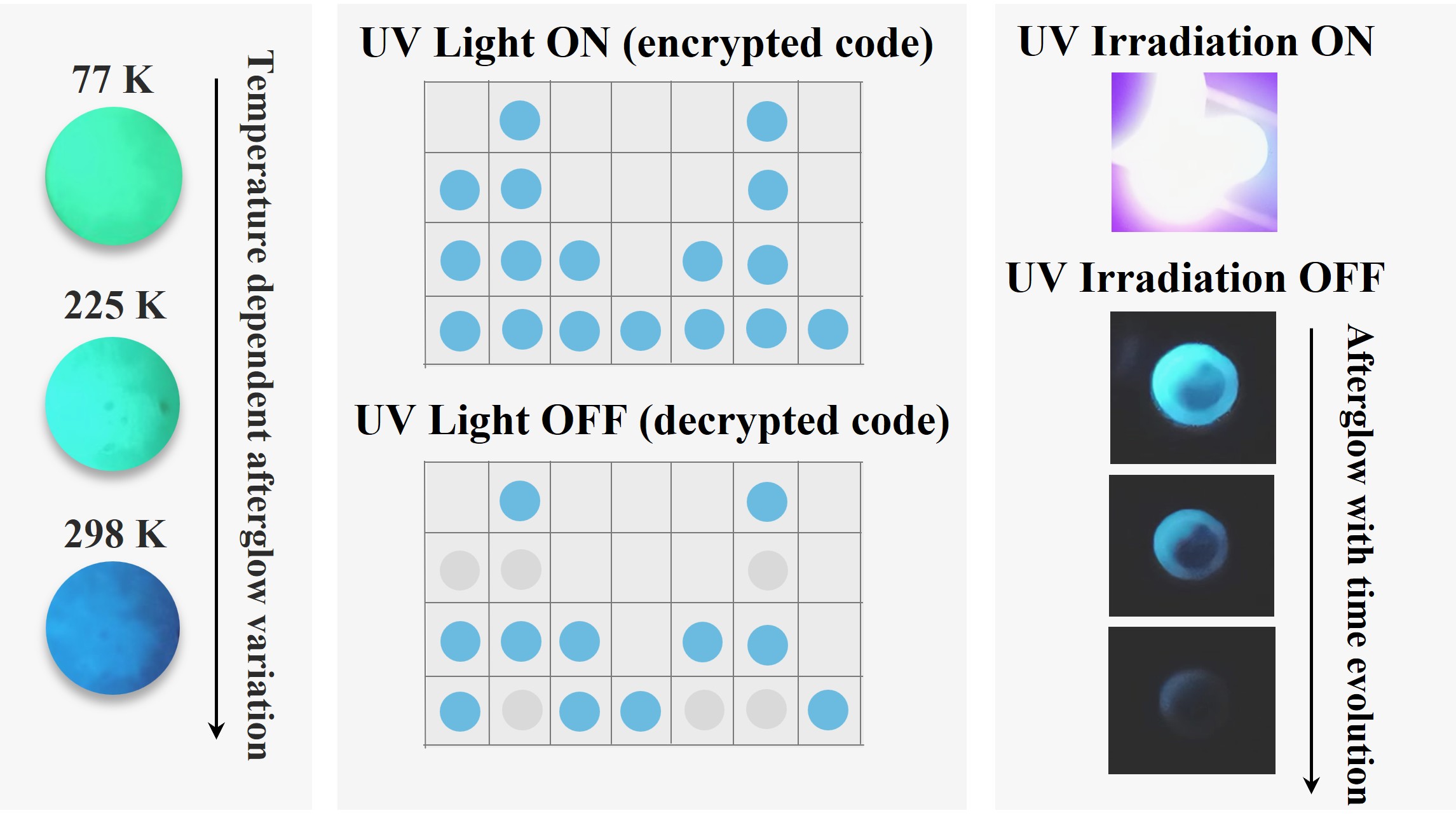
Left: Temperature-dependent change in the afterglow colour under oxygen-free conditions. Middle: Encryption and decryption of protected data for anti-counterfeiting applications under oxygen-free conditions. Right: Afterglow experiment under ambient conditions.
Many modern technologies, such as flexible displays, security inks, and smart sensors, depend on materials that emit light in a controlled and responsive manner. A particularly attractive feature is afterglow, where a material continues to shine even after the light source is switched off. However, achieving bright, long-lasting, and tunable afterglow at room temperature remains a major challenge, especially with environment-friendly organic materials.
In a recent study, researchers led by Pakkirisamy Thilagar at the Department of Inorganic and Physical Chemistry (IPC) present a new strategy to address this challenge by designing both the light-emitting molecule and its surrounding environment. They demonstrate that a common plastic-like material – a polymer matrix – is not merely a passive support but plays an active role in controlling how light is generated and maintained. By dispersing a specially designed organic molecule at very low concentration within this matrix, they created a transparent material that exhibits bright and persistent afterglow.
A key finding is that both the colour and intensity of the emitted light can be tuned with temperature. This behaviour arises from two distinct energy pathways within the molecule that can be selectively activated, enabling the material to switch between different glowing states. As a result, the system achieves a remarkably high light-emission efficiency of about 92%, which is rare for purely organic materials.
Importantly, this approach avoids complex synthesis and eliminates the need for toxic heavy metals, making it cost-effective and environmentally benign. These materials also enable practical applications, including hidden security features, temperature-responsive displays, and simple optical encoding such as Morse code, highlighting a versatile route to smart luminescent systems.
REFERENCE:
Ghosh S, Nandi RP, Shamil R, Lakshmanna YA, Geremia S, Hickey N, Sirohiwal A, Thilagar P, Polymer matrix drives thermal stimulation-caused dynamic phosphorescence in dispersed chromophores, Nature Communications (2026).
https://www.nature.com/articles/s41467-026-69664-x
Funding Acknowledgement:
This work was supported by the Anusandhan National Research Foundation (ANRF), Government of India.
LAB WEBSITE:
https://sites.google.com/view/ptlab-ipc-iisc



