Steering droplet motion with light
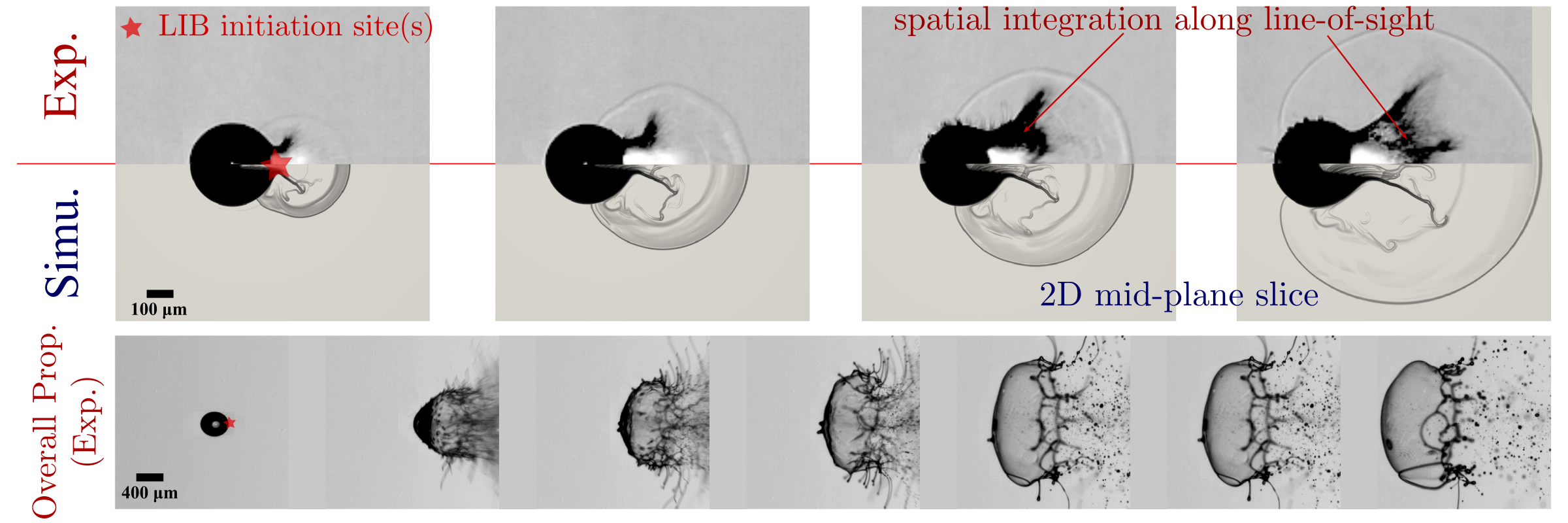
Laser-induced spatial shattering of levitated droplets (Image: Awanish Pratap Singh)
Laser-driven droplet motion is widely used in applications like microfluidics and targeted delivery of materials, but remains difficult to predict because the initial laser-triggered plasma spark can form at multiple locations in or near the droplet. Researchers led by Saptarshi Basu at the Department of Mechanical Engineering, IISc, and collaborators (Awanish Pratap Singh, Chaitanya Rao, Alfred Vogel and Mark Rahlves) have now developed a framework for controlling how free standing droplets break down and move using short laser pulses. The study was published in the Proceedings of the National Academy of Sciences.
The team demonstrated that two primary parameters – the droplet’s axial offset from the laser focal point and the energy of the incident pulse – dictate the exact location of laser-induced breakdown (LIB) of the droplet. They tracked acoustically levitated droplets driven by nanosecond laser pulses using high-speed imaging and optical simulations.
Using their experiments, they were able to establish a “first-crossing rule” that identifies the first location where the laser becomes intense enough to create a plasma spark – this could be at the illumination surface, within the interior of the droplet, at the droplet shadow surface, or in the air behind the droplet. This “first-crossing rule,” based on comparing local light intensity to experimentally measured breakdown thresholds, reliably predicts both the direction and morphology of droplet motion.
Pinpointing this first location helps determine the direction of the axial impulse, allowing researchers to select forward, backward, or near-radial propulsion.
Importantly, the study reveals distinct and stable operating regions where droplet responses are consistent, alongside narrow transition zones where small fluctuations can lead to dramatically different outcomes. This insight enables not just prediction of droplet motion but also robust control.
The findings provide a practical roadmap for tailoring laser-droplet interactions across applications – from inkjet printing and microfabrication to biomedical procedures and targeted drug delivery.
REFERENCE:
Singh AP, Rao DCK, Rahlves M, Vogel A, Basu S, Predicting and controlling laser-induced breakup and multidirectional propulsion of liquid droplets, Proceedings of the National Academy of Sciences (2026).
www.pnas.org/doi/10.1073/pnas.2526933123
LAB WEBSITE
https://mecheng.iisc.ac.in/project/saptarshi-basu/



